
Craftspeople Acquisition

Product
An online marketplace connecting homeowners and craftspeople
My role
Support in conducting interviews and evaluating results, facilitating a workshop, and proposing design changes
Team
Me, a UX researcher, and 2 UX designers
Timeline
Q1 2021
Problem
MyHammer was losing craftspeople between sign-up and their first client contact. It took craftsmen more than 2 weeks to register and up to a month to contact their first client.
Outcome
Two rounds of interviews with 21 craftspeople who stalled showed that document verification, not the registration form itself, was the biggest blocker. My proposals led to a redesigned document upload, fewer registration steps, and earlier job visibility.
Problem
What users and the business struggled with
MyHammer is a German marketplace where homeowners post jobs and craftspeople pay to contact them. The business wanted newly registered craftspeople to contact clients as quickly as possible.
In practice, many dropped out of the funnel, submitted their documents late, or never entered payment details. Registration often took more than 2 weeks, and the first client contact could take up to a month.
For craftspeople, this meant seeing attractive nearby jobs but not being allowed to bid while their documents were still being checked.
How we found out
Funnel data for Germany from 2020 showed where craftspeople were lost:
- The biggest drop came late. The biggest loss in the funnel happened after craftspeople had already signed up and confirmed their contract: during document vetting.
- The form lost people early. Within the registration form, the first step lost the most people, followed by the company data step.
- Few visitors became active. Only a small share of landing page visitors became active within their first month.
- Activation was slow. It could take several months from account creation to becoming active.
Goals
- For the research: recurring, explainable reasons for delay, and opportunity areas the team could act on.
- For the product: increase the share of craftspeople whose documents are approved within 7 days, backed by workshop-defined objectives.
Assumptions
- Payment details caused the drop-outs.
- Late documents meant low motivation.
- Choosing services would be a major hurdle.
- The type of trade, regulated or unregulated, would explain the reasons for the delay.
Research method
- Round 1: 7 remote interviews. Participants re-ran the registration on their own device while sharing their screen and talked through where they got stuck. Most were trades without qualification requirements.
- Round 2: 14 remote interviews focused on the regulated trades that must prove their qualification (for example, with a craft card from the Chamber of Crafts).
- Recruiting: Customer Support contacted craftspeople who had abandoned or stalled in the funnel, using their account data, and offered a reward. We mixed drop-out reasons, time spent in the funnel and trades.
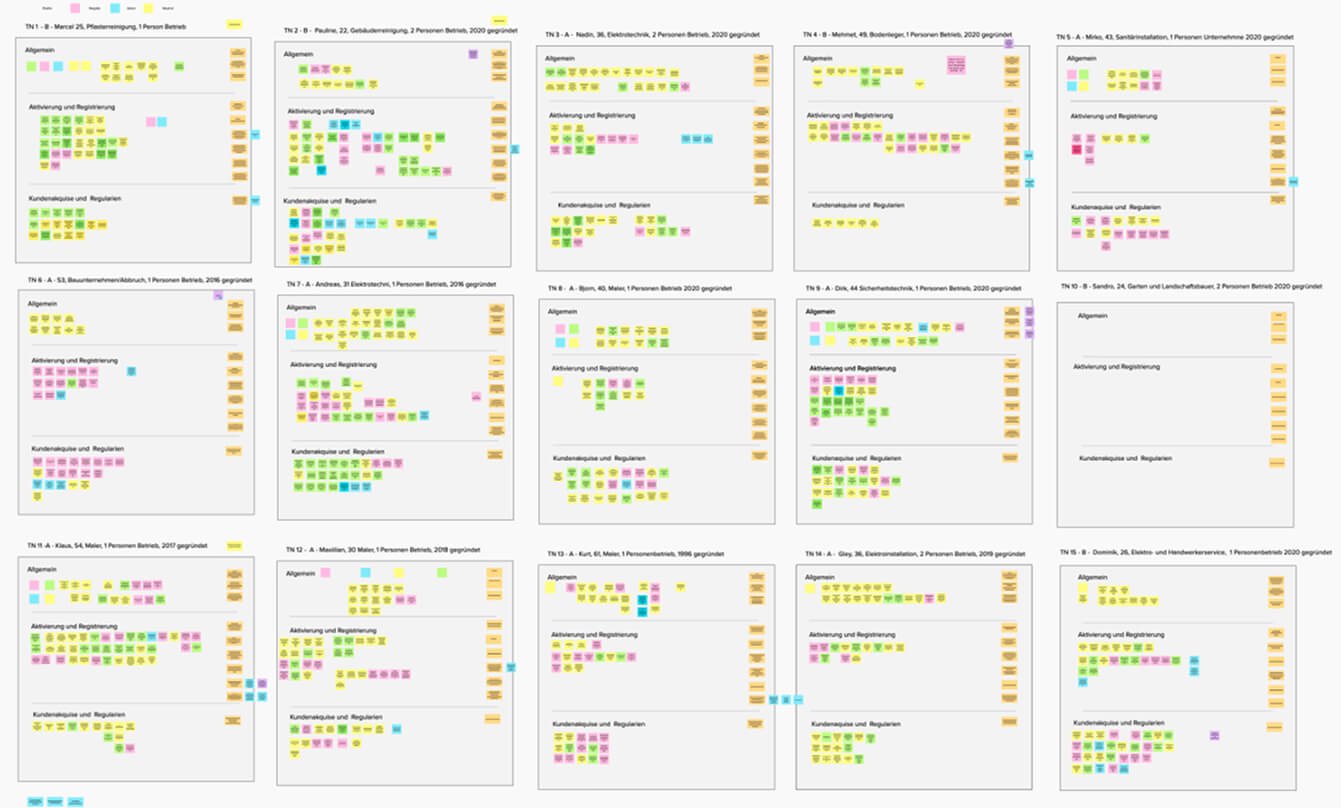
- Synthesis: Notes per participant in Miro, a timeline of what helped and what held back each person, affinity clustering, then a workshop with the product team.
Key decisions
1. Talk to the people who got stuck, not to happy users
Situation: The funnel data showed where we lost craftspeople, but not why. The people we needed to hear from were the ones least likely to talk to us.
Decision: Interview craftspeople who had abandoned registration or taken longer than 2 weeks. Customer Support recruited them, since it had the account data and an existing relationship. We mixed drop-out reasons, time in the funnel, and trades so no single story would dominate.
Trade-off accepted: Small, qualitative samples (7 and 14). The results explain why delays happen, not how often they happen across the market. One recruit couldn’t be interviewed because registration was too hard for him, which was a finding in itself.
2. Shift the focus for round 2
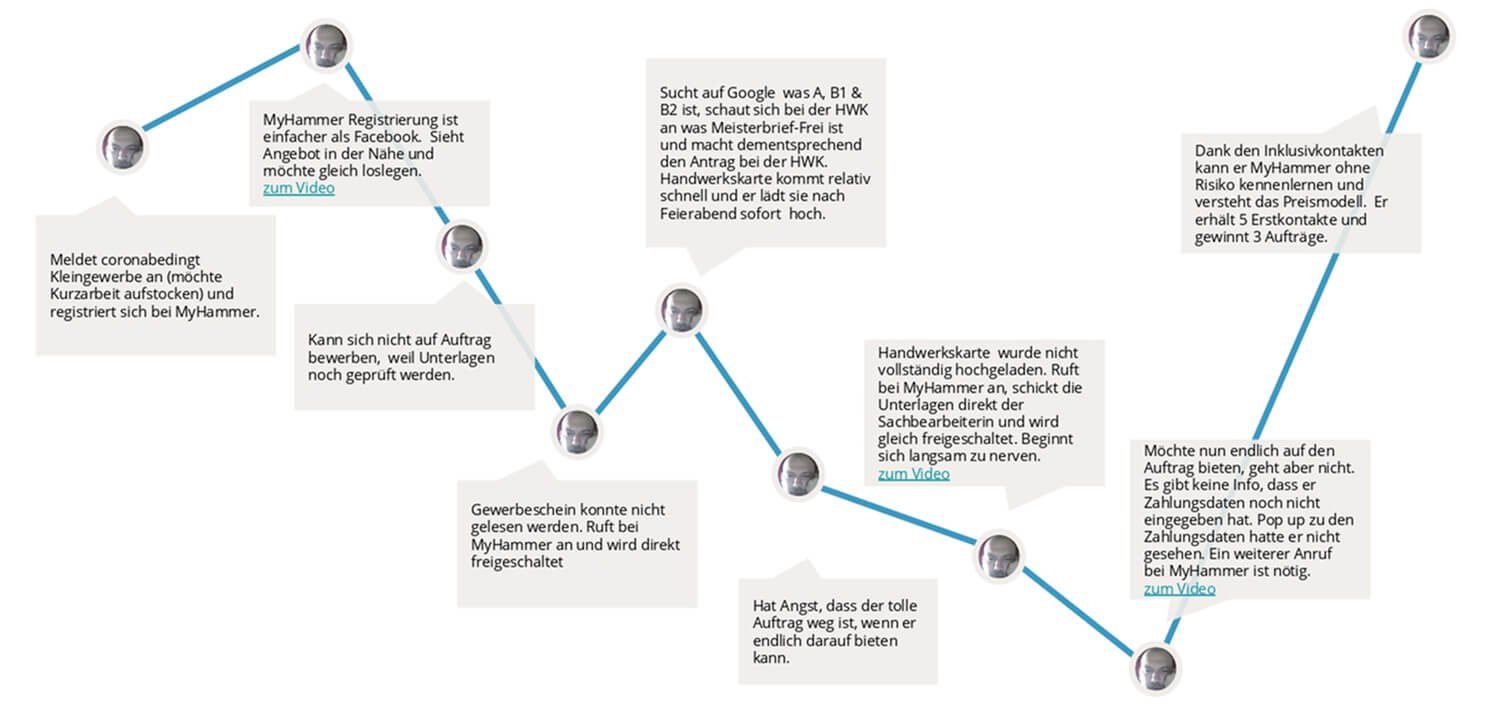
Situation: Round 1 covered mostly unregulated crafts. Participants re-ran a registration they already knew, so some reacted based on what they remembered rather than the flow. For example, most were irritated that they could pick only one main trade, which had not bothered them on their first real attempt.
Decision: Hire twice as many participants, focus on the regulated crafts, and use a story-based interview instead of a walkthrough: their business first, then why registration and activation took so long. This also let us cover activation, the phase after registration.
Trade-off accepted: Without the website in the session, we could not check service selection in detail.
3. Segment by business situation, not only by trade type
Situation: The team expected the type of trade, regulated or unregulated, to explain behavior. Round 1 suggested this, as participants from unregulated trades often had low technical affinity and limited industry knowledge. In round 2, that pattern did not show up for regulated trades, yet people in the same group still behaved very differently.
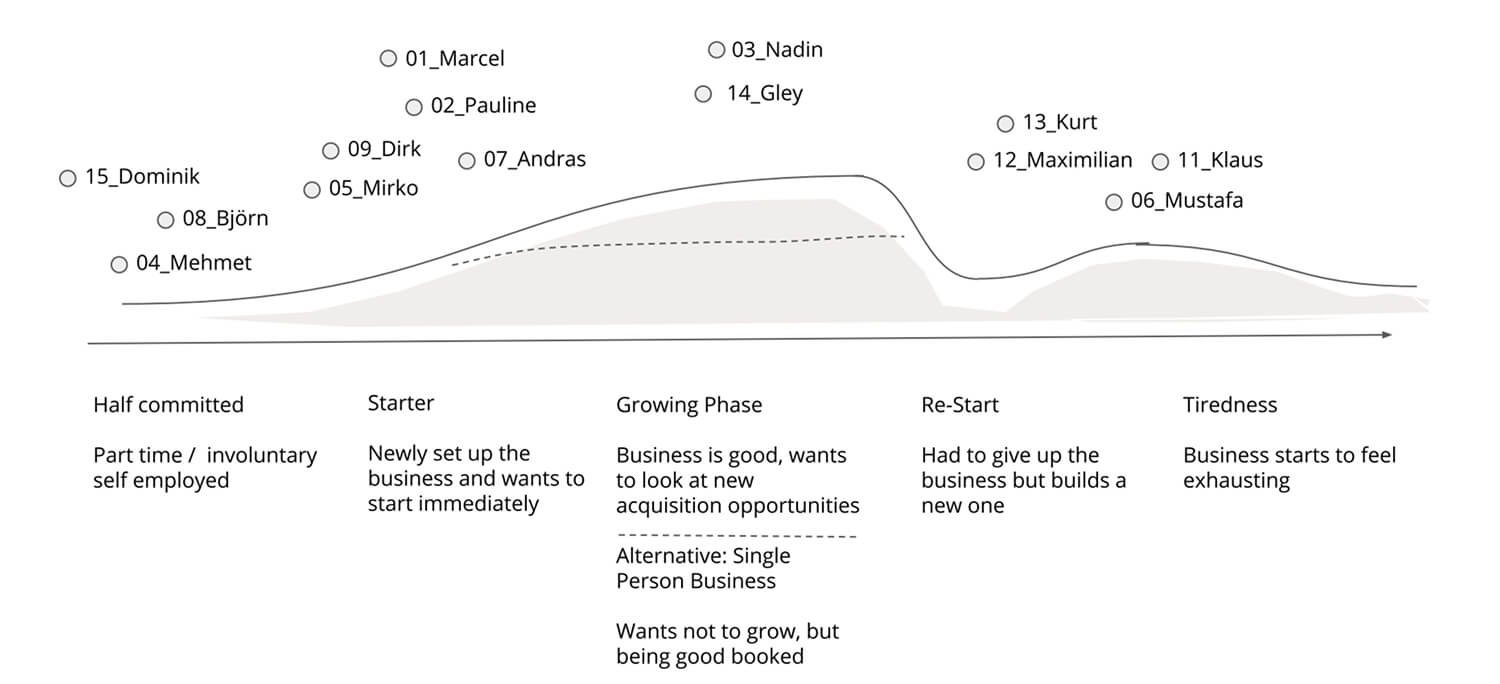
Observation: A starter wanted jobs immediately and accepted hurdles. A fully booked electrician used the platform only for small fill-in jobs and postponed problems. A painter near retirement only wanted to fill gaps. Urgency, not trade type, predicted whether a blocker got solved fast or pushed back.
Decision: Cluster users by lifecycle segments (Half committed, Starter, Single-person business, Growing, Re-start, Tiredness), each with its own job to be done, such as “Help me be fully booked” or “Help me with a soft start as a subcontractor”.
Trade-off accepted: The segments rest on 21 interviews and were not validated with data. The team listed checking them against behavioral data as an open step.
4. Turn findings into opportunity areas and an OKR workshop
Situation: Two rounds produced hundreds of notes. Designers, developers, product managers, and the CEO discussed notes between sessions, so they already shared context but needed a common direction.
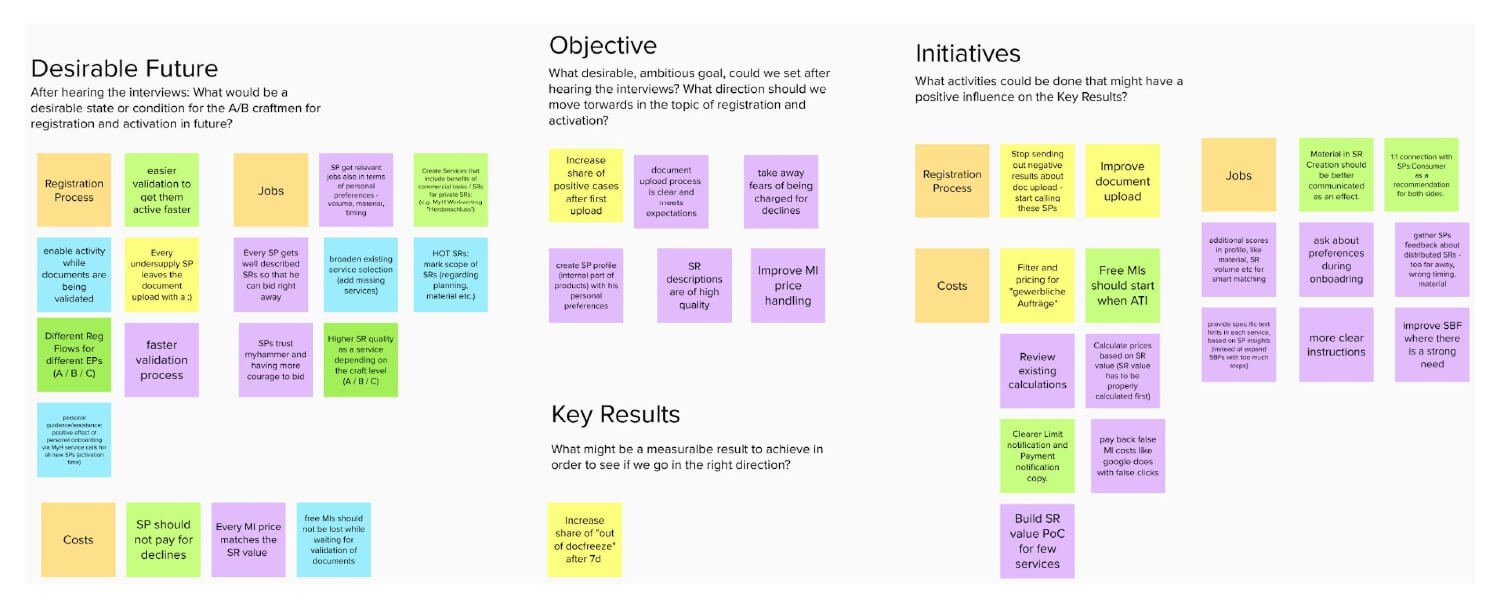
Decision: Five opportunity areas, framed from the craftsperson’s perspective by the research team before the workshop, then a workshop moving from a desired future to objectives, key results, and initiatives.
- Optimize document upload and validation (“Help me get through the upload with as little time as possible”)
- Reduce registration steps (for example, automatic data entry from documents, or a quick account setup followed by guided setup)
- Optimize activation (free exploration, fewer costs for declined contacts, better success rate)
- Optimize the profile (show that a complete profile and reviews raise the success rate)
- Help find the right leads (better job descriptions, filters such as private vs. commercial)
Trade-off accepted: These were directions, not solutions. Several ideas, such as real-time document validation, still needed feasibility checks.
Outcome
Key findings
- Documents were the number one registration blocker. In round 2, 8 of 14 had no craft card or an invalid one and had to deal with the authorities first. Rejection emails did not say what was wrong, so some uploaded the same file again (one person three times).
- Job quality and cost held back activation. Poor job descriptions (6 of 14), unprofitable jobs (4), no capacity or urgency (4), and paying for contacts that declined straight away (3).
- Costs were unclear at sign-up. In round 1, 4 of 7 didn’t know what MyHammer would cost after registration.
- Free contacts could expire while a craftsperson waited for the authorities to issue a craft card.
- Customer Support calls helped most often. 5 of 14 said support fixed their registration issue. One painter said that once support had set up his profile, it sold itself.
Assumptions vs. reality
- Payment details caused the drop-outs. The issue was trust, not the payment form. People wanted to try the platform before committing money, and free included contacts helped them understand when costs arise.
- Late documents meant low motivation. Many wanted to submit, but got rejection emails without a reason or were still waiting for a craft card.
- Choosing services would be a major hurdle. Mostly not. Only the marking of services that need a qualification was unclear.
- The type of trade would explain the reasons for the delay. Only partly. The business situation and urgency explained it better.
Limitations
- Recruited participants through Customer Support. People who quit silently were harder to reach, and support’s role may look bigger than it was.
- Memory over observation. Round 2 relied on people retelling events from weeks or months earlier.
- Small, qualitative sample. 21 interviews explain why people stalled, not how many. The funnel data covered the scale.
Impact
I turned several findings into proposals for the registration flow. Together with other changes, these were implemented:
- Document upload redesigned with clearer error messages, because rejection emails didn’t say what was wrong, and people re-uploaded the same file.
- Fewer registration steps, because the form lost people from its very first step.
- Jobs shown earlier, including high-quality ones, because craftspeople wanted to see value before committing money and paperwork.
- Sensitive information requested later, for the same reason: trust had to come before payment and document details.
Next steps
What I would do next:
- Measure the key result. Compare the share of craftspeople whose documents are approved within 7 days, before and after the new document upload, to learn which change made the difference.
- Turn support calls into product. Support fixed by phone what the product couldn’t. Build those fixes in: show upfront which document each service needs, and check readability during upload instead of days later.
- Stop the free trial expiring during verification. Start free contacts only once the account is approved, so craftspeople don’t lose them while waiting for a craft card.
- Fix the other side of the marketplace. Poor job descriptions held back activation. Guide homeowners through a step-by-step job request, so craftspeople can quote without a site visit.
Learnings
- Data shows where, people show why. The funnel pointed to document vetting. Only the interviews revealed missing craft cards and rejection emails without a reason.
- Ask people to retell, not redo. Re-running a flow they already knew changed what we observed.
- Support workarounds are design specs. Every case support fixed by phone showed what the product should do on its own. The clearer error messages came straight from that.
- Show value before asking for effort. Craftspeople wanted to see good jobs before handing over documents and payment details. That is why showing jobs earlier and asking for sensitive data later helped.